Summary: Student-athletes need to balance their time between training and studying. The road to NCAA Eligibility is a big commitment which may take even more time. Online school can help you simplify the daunting process and make sure that your child is on track to achieving NCAA Eligibility without compromising a quality education.
II. NCAA Academic Requirements
A. What Does NCAA Approval Mean?
B. What are the NCAA Core-Course Requirements?
III. Education-Impacting Disabilities
IV. What are the Benefits of Online High School for Student-Athletes?
V. How to Stay on Top of Your Academic Requirements for NCAA Eligibility
 Introduction
Having an athlete in the family is an incredibly exciting situation. An athletic journey can last throughout your child’s schooling and even become their professional careers. Competing in the NCAA is a dream that many student-athletes have. The NCAA is prestigious in more ways than one. Aside from celebrating sports, it also gives students access to health and wellness resources, chances to build their personal brands, and preparation for what their lives may look like after college. NCAA programs take care of student-athletes on and off the court.
Aiming for NCAA Eligibility might seem like a daunting process, but it can be very straightforward if you take things one step at a time. It is important to remember that your child is a student-athlete meaning they must juggle two hats at the same time. It is important to take care of both their athletic and academic requirements.
Taking your child’s athletic dreams seriously may take a lot of time and effort. They have to stay on top of both their athletic and academic responsibilities. Traditional school might be too constricting for this kind of setup. They may get burnt out juggling a rigid schedule and schoolwork with their training, competitions, and the travel time that it takes to get to all these places. Online school can help your student reach their NCAA dreams.
In this blog we’ll take you through the NCAA approved core-courses, how NCAA calculates a student’s GPA, the proper documentation for recruiters, and how online high school can help in every way.
NCAA Academic Requirements
For a student to train and compete (and possibly receive a scholarship) in the NCAA, students must be able to meet certain academic standards. Academic preparation is crucial. It is better to start as early as possible to ensure that your child is ready for the responsibility that it takes to maintain both their student and athlete duties.
What Does NCAA Approval Mean?
NCAA approved courses are high school classes that reach a standard of instruction which prepares students for college level education. These classes count towards a student’s eligibility. One of the first things that recruiters do when a student interests them is check out their readiness for college. Remember “student” comes first in “student-athlete”, recruiters need to make sure that the athletes they scout can handle doing both.
It is important to remember that not every school is NCAA approved. And for schools that are NCAA approved, not every course in the school may be an NCAA approved class. Always make sure to double check whether a class is NCAA approved because your child’s class credits may not be counted towards eligibility if it isn’t. This can be very discouraging and disrupt your child’s eligibility process.
Primavera Online School is one of the few online schools that is NCAA approved. NCAA’s approval is a testament to the quality of Primavera’s curriculum and the constant teacher-student interaction and support that we offer.
You can confirm this by searching “Primavera” in the high school name field in the NCAA official list of approved schools and courses. You can also see which NCAA approved classes we have to offer.
What are the NCAA Core-Course Requirements?
Aspiring student-athletes must complete 16 core-courses. These are the NCAA approved core–courses:
- English (ex. literature, composition)
- mathematics (ex. Algebra I or higher)
- natural or physical science (including 1 lab science if offered; ex. biology, chemistry, physics)
- social science (ex. history, civics, government)
- additional English, math, or science
- additional core-courses (ex. English, math, science, social science, world/foreign language, comparative/nondoctrinal religion, philosophy)
The specific standards needed for NCAA Eligibility depend on which division your child is aiming to enter. Here are the requirements for Division I and Division II. For Division III, the schools set their own academic standards that you must comply with, so make sure to check out the school’s individual requirements.
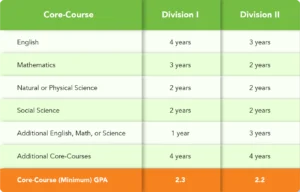
For Division I, there is also a rule known as the “10/7 Rule.” Students must complete 10 out of 16 of the courses before they start their senior year (7th semester). While 7 out of the 10 completed core-courses should be in English, math, or science. These grades will then be locked, meaning that you cannot retake the class to improve your grade. Recruiters also pay attention to the academic progression of student-athletes. They take note of the timeline of their studies just as much as the transcripts and grades, making sure they did not cram all their studies in one go.
How is the GPA Calculated?
The GPA to be considered will only be based on the grades received in the NCAA approved core-courses taken. This means that it may be slightly different from the cumulative GPA in your student’s transcripts.
If they take the same subject twice, then this will only count as one credit, and only the higher grade will be taken into consideration.
What Documents are Needed?
Make sure to prepare these documents in advance so that you are always ready if a recruiter shows up.
Grades and Transcripts
- You must have a copy of your child’s school transcripts which show their grades. If they went to multiple high schools, then you will need to prepare a transcript from each school that they attended. Consider having both a physical and digital copy of the transcripts so that you can give the information as quickly as possible when it is needed. Recruiters appreciate this kind of eagerness and preparation.
- Ensure that the school uploads the official high school transcripts for 2-3 consecutive academic years.
- Remember that one of the first things a recruiter will do if they are interested is to check a student’s grades to see if they are a permissible academic candidate for college.
Proof of Graduation
- You must also prepare your student’s high school diploma along with their final official high school transcript (from senior year). A GED may serve as an alternative proof of graduation but take note that this will not satisfy the requirement for the core-courses/core-course GPA.
SAT/ACT Scores
- SAT/ACT scores are no longer required for students aiming for Division I and Division II. For those aiming for Division III, you must check your desired school’s specific policy for this.
Athletic Documents
- The non-academic documents that you should prepare are:
- Athletic Resume – This should document the student’s athletic history. It must contain important personal information and statistics. List down any competitions they joined and any awards they’ve won. You may also include general academic information as well.
- Highlight Video – Show off your student’s skills in action. Collect game footage and demonstrations of their skills during training.
For more information, check out the NCAA Eligibility page. This is where you can review your transcripts, coursework, and check on your eligibility process. Create a profile and make sure to regularly update your page and check for any updates in requirements or your progress. You can also read their comprehensive Guide for the College Bound Student Athlete 2025-26 here.
Education-Impacting Disabilities
The NCAA also has guidelines for students with Education-Impacting Disabilities (EID). These are defined as any impairment that has a substantial impact on a student’s academic performance.
Some of the most common EIDs include learning disabilities, mental health conditions, and medical conditions.
Generally, students with EID have the same initial-eligibility standards, although accommodations may be given to help students meet these standards. There are also NCAA approved core-courses which are specifically designed for students with EID. To qualify for these, you may need to submit the following:
- current medical/psychoeducational evaluations
- documentation of accommodations received in school
- Individualized Education Programs (IEP) or 504 plans
- transcripts from all schools attended
- completed education-impacting disability services application
What are the Benefits of Online High Schools for Student-Athletes?
The road to NCAA Eligibility is time consuming. It may be overwhelming to think about the time needed to train, compete, travel between these places, and physically be in school for 7-8 hours a day. For the NCAA, exposure matters, how is your child going to be in two places at once? If your child attends a traditional school, then one will always have to give way to the other.
With online high school, you don’t have to work around a schedule to find time. School works with your schedule. The flexibility and personalized learning that online school can offer ensure that your child does not have to choose between training hard or studying hard. They will have time for both equally important aspects of their lives.
1. Flexibility
- At Primavera Online School, your child can learn whenever and wherever. They can get all their schoolwork done in the morning before training or save it all for the evening after they train. They can even sandwich either training or school between two separate sessions of the other. As long as they have a laptop/tablet and internet connection, anywhere can be a classroom. Even their gym or competition venues. Many of our students are able to keep a job, study, and still make time for themselves.
2. Personalized Learning
- Our incredibly qualified and compassionate staff will help you succeed both in and outside of academics. Our skilled teachers can help you deal with any concerns that your child may have with the lessons. While our staff can provide assistance throughout the NCAA Eligibility process. They can keep you on track with your goals and requirements, navigating the process together to make things less overwhelming.
3. Athletic Alumni
- Don’t just take our word for it. As an NCAA approved online school, we have many students who have successfully balanced their academic and athletic careers. They have went on to qualify for the NCAA and continued playing their beloved sports. Read up on our hockey star alumnus, Sean Barnhill, who entered Division I hockey at Northeastern University after high school with Primavera.
“I could not have pursued my tennis career the way I did without attending high school online. I was able to do all the traveling and pursue any opportunities that came my way because I could take my school with me anywhere I went.” says Meghan Lyall, tennis player and honors student, “Primavera offered me the flexibility I needed with my schooling, but the easily accessible help that I got from my teachers is really what benefited me the most.”
How to Stay on Top of Your Academic Requirements for NCAA Eligibility
1. Start as Early as Possible
- This entire process will be smoother the earlier that you begin your preparations. It is common for families to start preparing as early as 8th or 9th grade. Requirements needed are collected over time; it is not something that you can cram at the end of high school. Begin taking NCAA approved core–courses every school year. Registering early can also help you plan your child’s classes and assignments as the years go by. This will help you avoid any unnecessary causes of delay or confusion.
2. Constant Communication
- Speak with your guidance counselor and teachers regularly. Make sure they know that your student wants to play NCAA sports so that you can all create a concrete plan to get them there. You can all monitor your child’s grades as well. Constant checkups can reassure you that you are on track to accomplish all requirements needed for eligibility.
3. Stay Organized
- There are multiple documents and requirements needed for eligibility. Keeping track of your timeline and all your documents can give you more peace of mind. Having your files organized can also make it easier to reference and send to any recruiters.
4. Check Eligibility Center Regularly
- Keep eyes on the NCAA Eligibility site for any updates or announcements that they might have about eligibility and requirements.
5. Keep Your Account Updated
- Always ensure that your student’s academic and athletic history is up to date. Double check if you have any tasks you need to accomplish on the site, or missing information. Check that your child’s personal information is up to date as well, especially the contact information.
Ending Notes
Preparing for NCAA Eligibility doesn’t only setup your child’s academic and athletic careers for college, but possibly preps them for their lives outside of schooling. With Primavera Online School, your child can confidently work towards NCAA Eligibility without compromising between training or studying.
FAQs
1. What is an NCAA core-course?
- NCAA core-courses are approved high school classes that prime students for college level education.
- Aspiring student-athletes must complete 16 core-courses. These are the NCAA approved core–courses:
- English (ex. literature, composition)
- mathematics (ex. Algebra I or higher)
- natural or physical science (including 1 lab science if offered; ex. biology, chemistry, physics)
- social science (ex. history, civics, government)
- additional English, math, or science
- additional core-courses (ex. English, math, science, social science, world/foreign language, comparative/nondoctrinal religion, philosophy)
- Requirements for each core–course vary depending on the division your child is trying to enter. For Division I and Division II, refer to the table below. For Division III, each school may set their own academic standards for acceptance.
2. How does the NCAA calculate a student-athlete’s core-course GPA?
- The GPA to be considered will only be based on the grades received in the NCAA approved core-courses. This means that it may be slightly different from the cumulative GPA in your child’s transcripts.
- If they take the same subject twice, then this will only count as one credit, and only the higher grade will be taken into consideration.
3. Will the NCAA accept a diploma from an online high school?
- Yes, if the online school is NCAA approved and accredited, then the online school diploma will be recognized and accepted just as a traditional high school diploma would be.
- Rest assured that Primavera Online School is accredited by Cognia and NCAA approved. Approved core–courses taken with Primavera will count towards fulfilling NCAA Eligibility requirements.